Outdoor kitchen construction in Atlanta is a masonry and utility project that happens to end in a grill. The published numbers run across a wide band - 15,000 and 35,000 for a typical project, 8,000 and 15,000 for a basic built-in grill with modest countertops, and 20,000 and 50,000 for a full build with sink, fridge, pizza oven and stone counters - because the structure, the counter material and the utility runs are what you are actually buying. The published build is steel stud framing over a cement board substrate, finished in a stone or stucco exterior rated for 100+ degree heat, and a finished project is expected to give 15-25 years with proper maintenance, with many lasting even longer. Atlanta Outdoor Kitchens is a free matching service, not a provider: we route your request to licensed local builders, we do not employ contractors, and we do not sell outdoor kitchens services.
What it costs in Smyrna
| Job | Published 2026 range |
|---|---|
| Built-in gas grill, installed | 1,500 - 5,000 |
| Pizza oven, installed | 1,000 - 8,000 |
| Outdoor-rated refrigerator | 800 - 3,500 |
| Sink with plumbing | 300 - 2,000 |
| Gas line run from the meter | 400 - 2,000 |
| Low-voltage lighting package | 500 - 1,500 |
| Running gas, water and electric lines together | 2,000 - 5,000 |
| Underground line runs and trenching | 500 - 2,000 |
| Permit allowance | $75 - $400 |
| Removal or demolition, per unit | 25 - 60 |
What outdoor kitchen construction actually involves
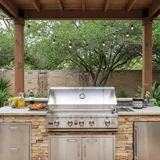
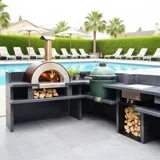
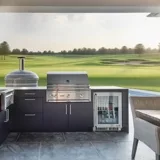
A built-in outdoor kitchen is a structure before it is a cooking station. The published build description is specific: built-in gas grills, smokers, pizza ovens, refrigerators and bar seating, framed with steel studs that will not rot the way wood does in humidity, clad over a cement board substrate that gives stone or tile a water-resistant base, and finished with a stone or stucco exterior rated for 100+ degree heat.
The order of the layers is what decides how long the whole thing lasts. Working from the ground up, a concrete base carries the full dead and live load; a waterproof layer sits over it; the plumbing penetrations are the deliberate holes through both, and they are where water gets in; and the aggregate or stone finish is the visible top of the stack. The countertop and the appliance heads sit above that, on a substrate that has to stay dry for any of it to work.
| Layer | Published description | What it decides |
|---|---|---|
| Base | A 4-inch reinforced concrete slab on compacted gravel | Carries the full dead and live load |
| Frame and substrate | Steel stud framing, cement board substrate | Will not rot like wood in humidity; a water-resistant base for stone or tile |
| Exterior | Stone or stucco rated for 100+ degree heat | Finish life under sun and weather |
| Countertop | Granite, concrete or porcelain tile | Must be UV-resistant and handle thermal shock from hot pans |
| Equipment | Built-in gas grill, smoker, pizza oven, refrigerator, bar seating | Footprint, utility runs and ventilation clearances |
Pavers are the lighter alternative base for smaller builds, but they shift under heavy masonry and appliances, which is why the published guidance settles on a 4-inch reinforced concrete slab on compacted gravel for anything built of masonry or stone.
The published cost bands, per project and per linear foot
There is no single price for an outdoor kitchen, and the source material publishes several bands because they answer different questions. Read them as scopes rather than as estimates that can be averaged into one number.
| Scope | Published band |
|---|---|
| Basic kitchen with a built-in grill and modest countertops | 8,000 and 15,000 |
| Modest kitchen with grill, counter and storage | 10,000 to 20,000 |
| Typical project range | 15,000 and 35,000 |
| Full build with sink, fridge, pizza oven and stone counters | 20,000 and 50,000 |
| Custom build with pergola, refrigeration, cabinetry, sink and outdoor fireplace | 25,000 to 50,000 |
| Full kitchen-and-pergola package | 30,000 and 50,000 |
| Budget shape across the market | $5K for basic grill setups to $75K+ for full luxury kitchens with pergolas, pizza ovens and bars |
Per linear foot is the other way the same job is quoted, and the published counter-run rates carry their own lifespans and sealing intervals.
| Counter run | Published rate | Lifespan | Re-seal interval | Annual maintenance |
|---|---|---|---|---|
| Masonry block island with stucco finish | $250-450/lf | 25 yrs | 3 yrs | 150 |
| Stone veneer masonry with granite counter | $400-670/lf | 30 yrs | 4 yrs | 200 |
| Modular stainless cabinets with stone top | $350-700/lf | 20 yrs | 0 | 80 |
| Framed island with poured concrete counter | $200-350/lf | 15 yrs | 2 yrs | 250 |
| Kitchen under a pergola or patio cover | $450-900/lf | 25 yrs | 3 yrs | 220 |
What moves a project inside a band is published too: appliances, countertop material, and utility runs are the big-ticket items. Prices vary by 30 to 40 percent for the same layout based on appliance brands and stone selection, weather-rated grills and refrigerators carry a 30 to 50 percent premium over indoor models, and underground line runs and trenching add 500 to 2,000 that many quotes leave out.
Why metro Atlanta is hard on a permanent structure
A built outdoor kitchen is asked to hold its shape through Atlanta's climate is humid subtropical with long, muggy summers: NWS Peachtree City's 1991-2020 normals for Atlanta give July and August mean temperatures of 80.2 F and 79.4 F against a 62.5 F annual mean, and the same station logged a single-day 3.61 inches of rain on 17 August 2021 - so summer convection is intense, not merely warm (NWS Atlanta/Peachtree City, Annual Climate Summary: https://www.weather.gov/ffc/Annual2021ClimateSummary). That heat-and-moisture load is why outdoor-kitchen spec in this market should default to a weather-rated or polymer/marine-grade cabinet box instead of standard MDF or particleboard, a sealed or non-porous countertop surface, and stainless or coated fasteners rather than plain steel. Winter is mild but not frost-free - Atlanta's January normal mean temperature is 43.3 F, low enough for repeated freeze-thaw at the surface - so any outdoor sink, ice maker or refrigerator line needs an accessible shutoff plus a drain-down valve, and footings should be detailed to resist heave rather than sized as if the site were frost-free. Tree pollen is the other local maintenance driver: Atlanta Allergy & Asthma operates the only National Allergy Bureau-certified pollen-count station in metro Atlanta and publishes the daily count in grains per cubic metre (https://www.atlantaallergy.com/pollen_counts), which is why open-air counters and grill surfaces here get covered and wiped down through the spring tree season.. That is the reason the published exterior specification is a stone or stucco finish rated for 100+ degree heat over steel stud framing rather than timber: steel will not rot the way wood does in humidity, and the cement board under the finish gives stone or tile a water-resistant base.
Water is the other half of the problem. The published guidance is that the slab should slope away from the structure and include a floor drain if the kitchen has a sink or ice maker, because poor drainage leads to standing water, moss, and rusted appliance bases. Site conditions belong in the pre-build conversation, not the punch list: site drainage and Metro Atlanta sits on the Georgia Piedmont, where the dominant residual soil is the Cecil series - fine, kaolinitic, thermic Typic Kanhapludults, described as a dark yellowish-brown sandy loam surface (Ap, 2-8 in) over a red clay subsoil (Bt) that runs 24-50 in thick, with Appling as the yellow-subsoil companion series and a frost-free period of 175-200 days (USDA-NRCS Official Series Description, Cecil: https://soilseries.sc.egov.usda.gov/OSD_Docs/C/Cecil.html). NRCS rates Cecil as well drained with a seasonal high water table deeper than 60 in and low shrink-swell (the kaolinite clay has low activity), so the soil does not heave like a smectite clay - but surface runoff is medium, the Bt horizon is dense, and on a graded lot storm water sheds across the surface rather than soaking in. For an outdoor kitchen that means the island should bear on a properly sized, over-excavated and compacted footing or a reinforced slab-on-grade rather than a surface pad, post and column footings should extend below the zone that is repeatedly wetted and dried and be backfilled with clean drainable material, and the design needs positive fall away from the structure with a defined discharge point rather than a soak-away. are two of the three things - weather patterns, soil characteristics, and building code requirements - that published guidance says to check before a design is finalized.
If the kitchen is going onto a wood deck, the published warning is direct. Wood decks are not designed for the weight and heat of masonry and built-in grills; they need a structural engineer review and heat shielding, or the deck may sag and pose a fire risk.
Living in metro Atlanta comes with its own set of common challenges, and every one of them has a proven, lasting solution when it is addressed by an experienced professional.
Local note for Smyrna
Smyrna is on the same Cecil/Appling Piedmont clay as the rest of Cobb and Fulton - red kaolinitic subsoil under a sandy loam surface, rated well drained with the water table deeper than 60 in (USDA-NRCS Cecil OSD: https://soilseries.sc.egov.usda.gov/OSD_Docs/C/Cecil.html). Because infiltration through that clay is slow, size any outdoor-kitchen drainage and downspout discharge for surface flow to a defined outlet rather than expecting the ground to take it.
Smyrna buys finished water from the Cobb County-Marietta Water Authority rather than treating its own; CCMWA draws from two sources, the Chattahoochee River and Lake Allatoona, and describes itself as Georgia's second-largest wholesale water provider, serving more than 900,000 residents (https://ccmwa.org/). The City of Smyrna publishes its own annual water quality report through its Utility Services division (https://www.smyrnaga.gov/departments/departments/finance/utility-services/annual-water-quality-report), and the city's permit-fee page directs all water and sewer fee questions to the Utility Department on 678-631-5338. Note on verification: smyrnaga.gov returned HTTP 403 to this datacenter IP on both curl and a real browser session (Cloudflare 'Access Denied'), so the page could not be fetched directly - the URL is the city's own and is live in an ordinary browser, and the number above is the one the city publishes on its own pages.
Utility accounts: City of Smyrna Utility Services Department (water purchased from Cobb County-Marietta Water Authority) · 678-631-5338
Checking a quote in Smyrna
- Is the quote itemised for the island, the countertop, the appliances and the connections, or is it one lump sum?
- Who pulls the gas and electrical permits, and is that cost in the quote?
- Is the countertop templated after the island is built, and what happens if the measurement is wrong?
- Are the appliances supplied by the contractor or by me, and who handles their warranty?
- What is the workmanship warranty on the masonry and the countertop, separately from the appliance warranties?
Frequently asked questions
What does outdoor kitchen construction cost in Atlanta?
Published bands run 8,000 and 15,000 for a basic kitchen with a built-in grill and modest countertops, 10,000 to 20,000 for a modest kitchen with grill, counter and storage, 15,000 and 35,000 for a typical project, 20,000 and 50,000 for a full build with sink, fridge, pizza oven and stone counters, and 25,000 to 50,000 for a custom build with pergola, refrigeration, cabinetry, sink and outdoor fireplace. Quoted by the linear foot, counter runs are published from $250-450/lf for a masonry block island with stucco finish up to $450-900/lf for a kitchen under a pergola or patio cover.
How long does an outdoor kitchen build take?
The published figures are two and six weeks from a signed agreement to completion, or 4 to 8 weeks from signed agreement to a finished build, with most builds running five weeks on average. From permit to finish the figure is 4 to 10 weeks, and custom stone and special-order grills can stretch the timeline to 12 weeks. Allow 10-25 days for HOA approval and permits alone.
How long does a built-in outdoor kitchen last?
A typical project is published at 15-25 years with proper maintenance, and many last even longer. By system, published lifespans are 25 yrs for a masonry block island with stucco finish, 30 yrs for stone veneer masonry with a granite counter, 20 yrs for modular stainless cabinets with a stone top, 15 yrs for a framed island with a poured concrete counter, and 25 yrs for a kitchen under a pergola or patio cover. Budget grills are the exception: thin steel rusts through in 1 to 3 years, against 10 to 15 years for 304 stainless burners and fireboxes.