Outdoor kitchens across metro Atlanta, with the county, the water utility and the permit office for each address.
Water and the sink line in Atlanta
The City of Atlanta Department of Watershed Management (DWM) is Atlanta's water utility and a regional wholesaler - it states it serves 1.2 million customers per day, and its drinking-water source is the Chattahoochee River. DWM publishes an annual Consumer Confidence Report and posts the current edition (the 2025 Water Quality Report) on its Water Quality Reports page (https://atlantawatershed.org/water-quality-reports/). For bills, service and water-main breaks the department directs customers to the ATL311 call centre on 404-546-0311, which is also the number its site advertises.
Utility accounts: City of Atlanta Department of Watershed Management · 404-546-0311
Utility: City of Atlanta Department of Watershed Management — 404-546-0311
Soil, drainage and the base
Atlanta is on Cecil/Appling Piedmont clay - the NRCS Cecil series description gives a thin dark yellowish-brown sandy loam surface over a dense red kaolinitic clay subsoil 24-50 in thick (https://soilseries.sc.egov.usda.gov/OSD_Docs/C/Cecil.html) - so a built-in island or masonry counter should bear on an over-excavated, compacted footing or a reinforced slab rather than on the surface, and the site still needs positive fall with a real discharge point because this clay moves storm water by surface runoff rather than percolation.
What the local stock means here
Atlanta sits in Fulton County (with a portion of the city in DeKalb County), served by City of Atlanta Department of Watershed Management. Atlanta's climate is humid subtropical with long, muggy summers: NWS Peachtree City's 1991-2020 normals for Atlanta give July and August mean temperatures of 80.2 F and 79.4 F against a 62.5 F annual mean, and the same station logged a single-day 3.61 inches of rain on 17 August 2021 - so summer convection is intense, not merely warm (NWS Atlanta/Peachtree City, Annual Climate Summary: https://www.weather.gov/ffc/Annual2021ClimateSummary). That heat-and-moisture load is why outdoor-kitchen spec in this market should default to a weather-rated or polymer/marine-grade cabinet box instead of standard MDF or particleboard, a sealed or non-porous countertop surface, and stainless or coated fasteners rather than plain steel. Winter is mild but not frost-free - Atlanta's January normal mean temperature is 43.3 F, low enough for repeated freeze-thaw at the surface - so any outdoor sink, ice maker or refrigerator line needs an accessible shutoff plus a drain-down valve, and footings should be detailed to resist heave rather than sized as if the site were frost-free. Tree pollen is the other local maintenance driver: Atlanta Allergy & Asthma operates the only National Allergy Bureau-certified pollen-count station in metro Atlanta and publishes the daily count in grains per cubic metre (https://www.atlantaallergy.com/pollen_counts), which is why open-air counters and grill surfaces here get covered and wiped down through the spring tree season.
What to check in this town
- Atlanta enforces the Georgia State Minimum Standard Codes rather than a local code of its own - the 2024 International Building, Residential, Plumbing, Mechanical and Fuel Gas Codes plus the 2023 National Electrical Code with the 2026 Georgia Amendments, effective 1 January 2026 (Georgia DCA: https://dca.georgia.gov/community-assistance/government-authority-reporting/construction-codes/current-state-minimum-codes). Because of that, a covered outdoor kitchen with a built-in gas grill, a sink and outdoor lighting is reviewed as a structure with multiple trades, not as 'just a patio', and DWM's own site reminds residents the department also runs stormwater and floodplain management - relevant to where a hardscape change is allowed to drain.
- Permits: Permits in this market are issued city by city, not county by county. In the City of Atlanta the residential and trade permits for an outdoor kitchen - structural/building, plus mechanical (which is the gas line), plumbing and electrical - come from the Office of Buildings inside the Department of City Planning at 55 Trinity Avenue SW, Atlanta GA 30303, filed through its online permitting system (https://atlantaga.gov/government/departments/city-planning/office-of-buildings/online-permitting-services; that page returns HTTP 403 to a datacenter IP but loads normally in a browser). Every other town in this market runs its own building department: Alpharetta Inspection & Code Enforcement, 2 Park Plaza (https://www.alpharetta.ga.us/departments/community-development/inspections-code-enforcement); Sandy Springs Community Development (https://sandyspringsga.gov/); Marietta (https://mariettaga.gov/); Decatur Design, Environment and Construction (https://www.decaturga.com/dec/page/how-obtain-permit, 404-377-6198); Brookhaven Community Development (https://www.brookhavenga.gov/263/Building-Permits, permit counter 404-637-0500); and Smyrna's own Building Division, not Cobb County (https://www.smyrnaga.gov/departments/departments/community-development-economic-development/building-division). County building departments do not issue these permits for in-city addresses.
- Call 811 before anyone breaks ground for the island footings, the gas run or a water line — free locate, several days' notice.
- In metro Atlanta the natural-gas distribution utility is Atlanta Gas Light (AGL), not Atmos Energy: AGL owns, operates and maintains the mains and the service line up to and including the meter, while the piping from the meter to the appliances is the customer's - and AGL's own guidance names grills and pool heaters explicitly as part of that customer-side outdoor piping (Atlanta Gas Light, Pipeline Safety: https://www.atlantagaslight.com/safety/safety-precautions/pipeline-safety.html). AGL has been a pipes-only company since 1998: it no longer sells gas, so the homeowner buys the commodity from one of the Commission-certified natural-gas marketers while the Georgia Public Service Commission still regulates AGL's distribution rates (Georgia PSC, Natural Gas: https://psc.ga.gov/utilities/natural-gas). Running a line to a built-in grill is fuel-gas work, so it needs a permit from the local building department plus inspection, and Georgia's State Minimum Standard Codes now run on the 2024 International Fuel Gas Code with the Georgia Amendments effective 1 January 2026 (Georgia DCA, Current State Minimum Codes for Construction: https://dca.georgia.gov/community-assistance/government-authority-reporting/construction-codes/current-state-minimum-codes). Gas piping in Georgia is licensed trade work under O.C.G.A. Title 43, Chapter 14 (covered by the state construction-industry licensing board's plumbing/utility-contractor scope, verified through the Secretary of State's licence lookup) - so use a licensed plumbing contractor rather than a handyman, and expect a pressure test and inspection before the piping is covered.
- Georgia's subdivision HOA statute is the Georgia Property Owners' Association Act (O.C.G.A. sections 44-3-220 to 44-3-235), and it is opt-in: a development is only governed by it if the recorded declaration states an affirmative election to be governed (section 44-3-222). Where it applies, the Act gives the association the power to grant or withhold approval of any action that would change the exterior appearance of a lot or any structure on it, and to create an architectural control committee for that purpose - the exact hook a metro-Atlanta HOA uses for a pergola, a built-in counter, a fireplace or a hardscape change (O.C.G.A. section 44-3-231: https://law.justia.com/codes/georgia/title-44/chapter-3/article-6/section-44-3-231/). Practical consequence for a homeowner here: pull the recorded declaration and covenants from the county Superior Court Clerk before design, look for a post-1994 submission to the Act and for the ARC's published standards, and get written architectural approval before signing a build contract, because setbacks, fence heights, impervious-coverage limits and even counter or cabinet finishes are commonly restricted in metro-Atlanta subdivisions.
Jobs we can route here
- Outdoor Kitchen Construction
- Pergolas and Patio Covers
- Outdoor Fireplaces
- Outdoor Bar Construction
- Outdoor Kitchen Lighting
- Outdoor Pizza Ovens
Costs in Atlanta
| Job | Published range |
|---|---|
| Typical outdoor kitchen project | 15,000 - 35,000 |
| Basic kitchen, built-in grill and modest counters | 8,000 - 15,000 |
| Custom build, pergola, refrigeration, sink, fireplace | 25,000 - 50,000 |
| Kitchen plus pergola package | 30,000 - 50,000 |
| Outdoor fireplace | 12,000 - 40,000 |
| Pergola add-on (lighting, fans or retractable cover) | 4,000 - 12,000 |
| Masonry block island with stucco finish, per linear foot | $250-450/lf |
| Stone veneer masonry with granite counter, per linear foot | $400-670/lf |
| Modular stainless cabinets with stone top, per linear foot | $350-700/lf |
| Framed island with poured concrete counter, per linear foot | $200-350/lf |
| Kitchen under a pergola or patio cover, per linear foot | $450-900/lf |
| Bar-height counter run only, per linear foot | $180-320/lf |
Outdoor Kitchens services in Atlanta
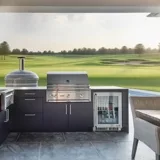
Atlanta Outdoor Kitchen Construction
Outdoor Kitchen Construction in Atlanta, GA - local costs and what the job includes.
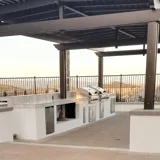
Atlanta Outdoor Kitchen Pergola And Patio Cover
Pergolas and Patio Covers in Atlanta, GA - local costs and what the job includes.
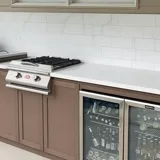
Atlanta Outdoor Kitchen Fireplace
Outdoor Fireplaces in Atlanta, GA - local costs and what the job includes.

Atlanta Outdoor Kitchen Bar Construction
Outdoor Bar Construction in Atlanta, GA - local costs and what the job includes.
Atlanta Outdoor Kitchen Lighting
Outdoor Kitchen Lighting in Atlanta, GA - local costs and what the job includes.
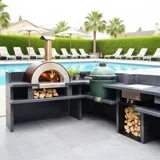
Atlanta Outdoor Kitchen Pizza Oven
Outdoor Pizza Ovens in Atlanta, GA - local costs and what the job includes.