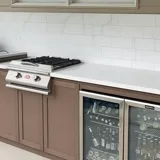
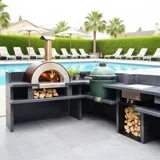
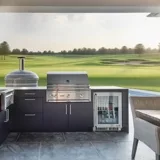
A custom outdoor fireplace is published as wood-burning or gas, with gas fire pits as the smaller alternative. The published cost bands are clear about scale: the fireplace-specific band is 12,000 to 40,000 depending on size and stone, an installed outdoor fireplace as an add-on to an existing kitchen is 2,000 - 8,000, and the site-wide project band is 15,000 and 35,000, with 25,000 to 50,000 published for a custom build that includes a pergola, refrigeration, cabinetry, sink and an outdoor fireplace. The published payoff is social rather than financial: adding a fireplace is reported to increase outdoor-space use by roughly twice as much. Atlanta Outdoor Kitchens is a free matching service, not a provider - we route your request to licensed local builders and we do not employ contractors.
What it costs in Marietta
| Job | Published 2026 range |
|---|---|
| Built-in gas grill, installed | 1,500 - 5,000 |
| Pizza oven, installed | 1,000 - 8,000 |
| Outdoor-rated refrigerator | 800 - 3,500 |
| Sink with plumbing | 300 - 2,000 |
| Gas line run from the meter | 400 - 2,000 |
| Low-voltage lighting package | 500 - 1,500 |
| Running gas, water and electric lines together | 2,000 - 5,000 |
| Underground line runs and trenching | 500 - 2,000 |
| Permit allowance | $75 - $400 |
| Removal or demolition, per unit | 25 - 60 |
What an outdoor fireplace build actually involves
The published specification is a built structure, not a fire pit with a chimney. A custom fireplace is wood-burning or gas, with a firebrick-lined firebox that withstands 1,800-degree temperatures, a steel reinforced concrete cap over the firebox, and a stone veneer or full-bed stone exterior that matches the outdoor kitchen it sits beside. A built-in seating wall typically completes the assembly.
Those three details - the firebrick lining, the reinforced cap and the mass of the surround - are what separate a fireplace that lasts from a decorative box that cracks. Masonry works by storing heat and releasing it slowly, which is why the structure is heavy and why the footing under it matters more than the finish on it.
| Component | Published specification | What it does |
|---|---|---|
| Firebox | Firebrick-lined, withstands 1,800-degree temperatures | Contains the fire without spalling the masonry |
| Cap | Steel reinforced concrete cap | Closes the top of the surround against weather |
| Exterior | Stone veneer or full-bed stone | Matches the outdoor kitchen and protects the mass |
| Seating | Built-in seating wall | Turns the fireplace into a room, not an object |
| Base | A 4-inch reinforced concrete slab on compacted gravel | Carries the weight of masonry and the firebox |
Gas fire features are the lighter path. A gas fire pit or gas fireplace still needs a gas line run from the meter, a permitted connection and clearance to combustibles, but it does not need the mass of a wood-burning chimney and it starts with a switch rather than a fire.
Published cost bands and what size and stone change
The fireplace band is the one item that is published separately from the rest of the project, because size and stone drive it more than anything else does.
| Scope | Published band |
|---|---|
| Outdoor fireplace, depending on size and stone | 12,000 to 40,000 |
| Installed outdoor fireplace as an add-on | 2,000 - 8,000 |
| Typical project range | 15,000 and 35,000 |
| Custom build with pergola, refrigeration, cabinetry, sink and outdoor fireplace | 25,000 to 50,000 |
| Counter run, stone veneer masonry with granite counter | $400-670/lf |
| Counter run, masonry block island with stucco finish | $250-450/lf |
The spread inside the 12,000 to 40,000 band is explained by the same published cost drivers as the rest of the niche: appliances, countertop material, and utility runs are the big-ticket items, and prices vary by 30 to 40 percent for the same layout based on appliance brands and stone selection. A fireplace quoted as full-bed stone against the same footprint framed in veneer over block is a different structure with a different footing, which is why the two quotes should not be compared line by line.
Where the fireplace is fed by gas, add the published gas line run from the meter at 400 - 2,000, and allow for underground line runs and trenching at 500 to 2,000 that many quotes leave out. Running gas, water and electric lines to a new outdoor zone is published at 2,000 to 5,000.
Fire performance, clearances and metro Atlanta conditions
The published ventilation rule applies to every cooking and heat appliance in the zone: open-air builds need no mechanical ventilation, but covered or enclosed areas require a rated vent hood, because an under-counter appliance or an enclosed room without airflow traps smoke and heat, damaging finishes. A fireplace under a solid cover is exactly the case that rule is written for.
Gas appliances carry their own published requirement - proper ventilation for gas appliances and the code-required clearances - and the failure signals published for a gas line are specific: a gas smell, weak flame, or hissing at a fitting means the line needs attention immediately, and a licensed pro should pressure-test the line and confirm the system is safe before you cook. Stainless and weather-rated construction, sealed electrical connections, and covers rated for UV exposure are the published list for anything that lives outdoors.
Atlanta's climate is humid subtropical with long, muggy summers: NWS Peachtree City's 1991-2020 normals for Atlanta give July and August mean temperatures of 80.2 F and 79.4 F against a 62.5 F annual mean, and the same station logged a single-day 3.61 inches of rain on 17 August 2021 - so summer convection is intense, not merely warm (NWS Atlanta/Peachtree City, Annual Climate Summary: https://www.weather.gov/ffc/Annual2021ClimateSummary). That heat-and-moisture load is why outdoor-kitchen spec in this market should default to a weather-rated or polymer/marine-grade cabinet box instead of standard MDF or particleboard, a sealed or non-porous countertop surface, and stainless or coated fasteners rather than plain steel. Winter is mild but not frost-free - Atlanta's January normal mean temperature is 43.3 F, low enough for repeated freeze-thaw at the surface - so any outdoor sink, ice maker or refrigerator line needs an accessible shutoff plus a drain-down valve, and footings should be detailed to resist heave rather than sized as if the site were frost-free. Tree pollen is the other local maintenance driver: Atlanta Allergy & Asthma operates the only National Allergy Bureau-certified pollen-count station in metro Atlanta and publishes the daily count in grains per cubic metre (https://www.atlantaallergy.com/pollen_counts), which is why open-air counters and grill surfaces here get covered and wiped down through the spring tree season. shapes the rest of the specification. Materials published as holding up best in heat and humidity are powder-coated aluminum and stainless steel, along with stone or brick veneer for the structure, with pressure-treated or cedar frames working well when sealed properly. Around the footings, Metro Atlanta sits on the Georgia Piedmont, where the dominant residual soil is the Cecil series - fine, kaolinitic, thermic Typic Kanhapludults, described as a dark yellowish-brown sandy loam surface (Ap, 2-8 in) over a red clay subsoil (Bt) that runs 24-50 in thick, with Appling as the yellow-subsoil companion series and a frost-free period of 175-200 days (USDA-NRCS Official Series Description, Cecil: https://soilseries.sc.egov.usda.gov/OSD_Docs/C/Cecil.html). NRCS rates Cecil as well drained with a seasonal high water table deeper than 60 in and low shrink-swell (the kaolinite clay has low activity), so the soil does not heave like a smectite clay - but surface runoff is medium, the Bt horizon is dense, and on a graded lot storm water sheds across the surface rather than soaking in. For an outdoor kitchen that means the island should bear on a properly sized, over-excavated and compacted footing or a reinforced slab-on-grade rather than a surface pad, post and column footings should extend below the zone that is repeatedly wetted and dried and be backfilled with clean drainable material, and the design needs positive fall away from the structure with a defined discharge point rather than a soak-away. and site drainage decide how the base is built: the slab should slope away from the structure, poor drainage leads to standing water, moss, and rusted appliance bases, and site drainage is one of the three things - weather patterns, soil characteristics, and building code requirements - that published guidance says to check before a design is finalized.
Local note for Marietta
Marietta is on the same Piedmont profile as the rest of the metro - the Cecil series' dark yellowish-brown sandy loam over red kaolinitic clay 24-50 in thick, well drained with the water table below 60 in (USDA-NRCS Cecil OSD: https://soilseries.sc.egov.usda.gov/OSD_Docs/C/Cecil.html). Because the clay sheds water by runoff rather than absorbing it, a built-in island here wants a compacted, over-excavated bearing point plus grade falling away from the house to a defined outlet, not a level pad.
Marietta runs its own utility, 'Marietta Water', under the city's Board of Lights and Water, and it purchases finished water from the Cobb County-Marietta Water Authority (CCMWA), a regional public utility founded in 1951 whose two sources are the Chattahoochee River and Lake Allatoona (https://mariettaga.gov/502/Water). CCMWA describes itself as the second-largest wholesale water provider in Georgia, serving more than 900,000 residents from the James E. Quarles and Hugh A. Wyckoff treatment plants, each with 86 MGD of treatment capacity (https://ccmwa.org/). Marietta Power & Water customer service is 770-794-5150, with a 24-hour water emergency line on 770-794-5230.
Utility accounts: City of Marietta Board of Lights and Water (Marietta Power & Water) · 770-794-5150
Checking a quote in Marietta
- Is the quote itemised for the island, the countertop, the appliances and the connections, or is it one lump sum?
- Who pulls the gas and electrical permits, and is that cost in the quote?
- Is the countertop templated after the island is built, and what happens if the measurement is wrong?
- Are the appliances supplied by the contractor or by me, and who handles their warranty?
- What is the workmanship warranty on the masonry and the countertop, separately from the appliance warranties?
Frequently asked questions
How much does an outdoor fireplace cost in Atlanta?
The fireplace-specific published band is 12,000 to 40,000 depending on size and stone. Added to an existing outdoor kitchen, an installed outdoor fireplace is published at 2,000 - 8,000. For context, the typical project range is 15,000 and 35,000, and a custom build with a pergola, refrigeration, cabinetry, sink and outdoor fireplace is published at 25,000 to 50,000. A gas feed adds a published line run from the meter at 400 - 2,000.
Should I choose wood-burning or gas?
Both are published options, and the trade-off is in the specification. Wood-burning requires a spark screen and a code-compliant chimney height, and the local position on wood-burning with a proper spark arrestor should be confirmed with Permits in this market are issued city by city, not county by county. In the City of Atlanta the residential and trade permits for an outdoor kitchen - structural/building, plus mechanical (which is the gas line), plumbing and electrical - come from the Office of Buildings inside the Department of City Planning at 55 Trinity Avenue SW, Atlanta GA 30303, filed through its online permitting system (https://atlantaga.gov/government/departments/city-planning/office-of-buildings/online-permitting-services; that page returns HTTP 403 to a datacenter IP but loads normally in a browser). Every other town in this market runs its own building department: Alpharetta Inspection & Code Enforcement, 2 Park Plaza (https://www.alpharetta.ga.us/departments/community-development/inspections-code-enforcement); Sandy Springs Community Development (https://sandyspringsga.gov/); Marietta (https://mariettaga.gov/); Decatur Design, Environment and Construction (https://www.decaturga.com/dec/page/how-obtain-permit, 404-377-6198); Brookhaven Community Development (https://www.brookhavenga.gov/263/Building-Permits, permit counter 404-637-0500); and Smyrna's own Building Division, not Cobb County (https://www.smyrnaga.gov/departments/departments/community-development-economic-development/building-division). County building departments do not issue these permits for in-city addresses.. Gas needs a permitted line run from the meter by a licensed plumber, sized to the total BTU of every appliance, with the code-required clearances. Either way the firebox stays firebrick-lined and rated for 1,800-degree temperatures.
Does an outdoor fireplace need a permit?
A covered structure or any gas, electrical or plumbing work usually requires one - a gas line is published as requiring a permit and a licensed plumber, and anything over 12 ft tall usually triggers a permit as well. Published permit costs run 100-500 through the building department, with a calculator allowance of 75 - 400; the two published figures disagree, so confirm which applies to your scope.